
BMLEH: BallanceID
Our diet is at the intersection between individual preferences and global challenges such as environmental pollution and health. Recommendations such as those of the DGE emphasise a plant-based diet and a higher fibre intake. However, due to their properties, dietary fibres often impair the sensory quality of food. Particularly in communal catering for vulnerable groups such as the elderly or the sick, for example in care catering, a healthy diet and therefore a high fibre intake with consistently high sensory quality is crucial. Our solution is innovative ‘Textured Meal Components’ (TMCs), which are developed as wholesome, plant-based and fibre-enriched menu components and are not just substitute products. These should offer a high level of acceptance and flexibility in order to fulfil special nutritional requirements. The BallanceID project develops and implements TMCs, taking into account regionality, sustainability, consumer acceptance and cost-effectiveness. It promises innovations along the value chain with the aim of establishing healthier and more sustainable nutrition in communal catering, particularly in care catering. Results are utilised and further developed in a practical manner.
For more information: https://service.ble.de/ptdb/index2.php?detail_id=119832095&ssk=PTDB-alles&site_key=141&stichw=BallanceID&sLfd=laufend&zeilenzahl_zaehler=9#newContent
Duration of the project:
DFG: Human Perception and Cognition during Interaction
The RTG coHu investigates how future human-system interfaces can be designed to enable intuitive, reliable, and safe interaction between humans and technology. By combining co-design methodologies with human-in-the-loop approaches, we seek to create interactive systems that account for both human needs and technical requirements from the earliest stages of development. While our research is broadly applicable to interactive systems, particular emphasis is placed on challenges arising in medical engineering and medical robotics.
RA2-SP3 – Human Perception and Cognition during Interaction
This subproject investigates how users perceive and cognitively integrate assistive systems during interaction. It focuses on how robotic devices can become embodied, being perceived as extensions of the body and action capabilities.
SP3 studies multisensory integration and neurocognitive mechanisms underlying learning and control of assistive devices.
It combines behavioral experiments, computational modeling, and neurophysiological measurements to analyze perception and embodiment.
For more information: https://www.cohu.fau.eu/
Duration of the project:
DFG: Olfactory-visual causal inference in perception and the brain (OLVICI; RO 5587/1-1)
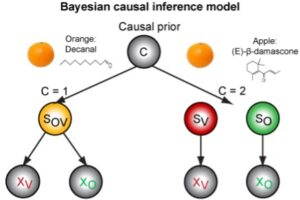
Humans integrate sensory stimuli from the physical (e.g. sight, hearing, touch) and chemical senses (e.g. smell, taste) into a coherent multisensory perception of their environment and evaluate it. For example, we perceive food based on its appearance and odour and evaluate whether we like a food or not. However, our brain should only integrate and evaluate multisensory stimuli that can originate from a common cause: When seeing and smelling food, the brain must first infer whether the appearance and smell were actually caused by a single food, and not by different foods or other odour sources. This project uses psychophysical, psychophysiological and EEG methods to investigate how humans infer the causal structure of olfactory-visual food stimuli, integrate or segregate the stimuli and finally evaluate their multisensory pleasantness. The results will significantly expand our understanding of how the brain forms, evaluates and expresses the multisensory perception of food.
Duration of the project: 2023-2026
DFG: The interplay of multisensory causal inference and attention in audiovisual perception (MultiAttend, RO 5587/5-1)
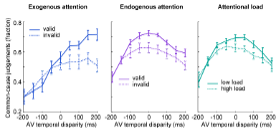
In our everyday environment, our brain constantly combines a multitude of multisensory stimuli into a coherent multisensory perception of the environment. For example, we correctly perceive which voices belong to which faces at a party. In order to link the stimuli veridically, the brain should only combine stimuli from one source (such as a speaker). However, the brain only has limited attentional capacities to process the multisensory stimuli and to focus on relevant stimuli (e.g. the conversation partner). The brain therefore has to solve two challenges: First, it must infer the causal structure of the multisensory stimuli in order to integrate them in the case of a common cause or to segregate them in the case of independent causes. Second, the brain must use selective attention to focus its limited attentional resources to relevant stimuli in the competition of multisensory stimuli. The current project investigates the interplay of multisensory causal inference and attention in audiovisual perception using psychophysics, electroencephalography (EEG) and Bayesian computational modelling.
Project duration: 2024-2027
DFG: The neural dynamics of causal evidence accumulation in multisensory perception (MultiCEA)
In everyday life, our brain continuously combines information from different senses to form a coherent overall picture – for example, in a noisy environment, we associate a speaker’s voice with the corresponding lip movements. To ensure that our perception remains reliable, the brain should only combine sensory information if they are likely to originate from the same source, while signals from independent sources are processed separately. Previous research has provided important insights into this, but has mostly focused on short, rather static stimuli. In the real world, however, perception takes place in dynamic situations in which stimuli are constantly changing and the brain can collect information over time to reduce uncertainty. For example, at a party with many people talking, the brain can collect information over long periods of time to decide which voice belongs to which face.
In this project, we use audiovisual perception experiments, neuroimaging (EEG & fMRI) and computational models to investigate how the brain weighs competing explanations for audiovisual sensory impressions and makes a decision to integrate or segregate sensory information. Using a time-resolved, model-based approach, we aim to better understand how the brain achieves stable multisensory perception in complex, rapidly changing environments.
Duration: 2026-2029