
We investigate how humans perceive their environment. How and why do light patterns on our retina create the impression of an external visual object, such as a face? How does our brain translate sound frequencies into speech or music? Why do we experience molecules that enter our nose as odours? And how does the brain manage to combine very different sensory impressions from sight, hearing, smell and touch into a unified, multisensory perception of an object or event – such as a food we eat?
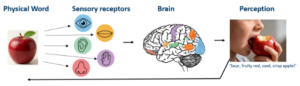
In our basic research, we investigate these questions using methods from psychophysics and experimental psychology in controlled laboratory experiments and measure the brain’s neural activity using imaging techniques (e.g. EEG and fMRI).
At the same time, we want to translate the findings of our basic research into concrete applications. For example, how can we better understand altered perception in mental illness and thus diagnose it more accurately? How can we capture the perception of a robotic prosthesis and improve it so that it feels more like a part of one’s own body and can be controlled more intuitively? And how can the multisensory perception of food be described and altered so that novel, 3D-printed foods are experienced as tasty?In our applied research, we investigate such questions using laboratory experiments, sensory analyses in consumer studies and real-world laboratory studies, among other methods